
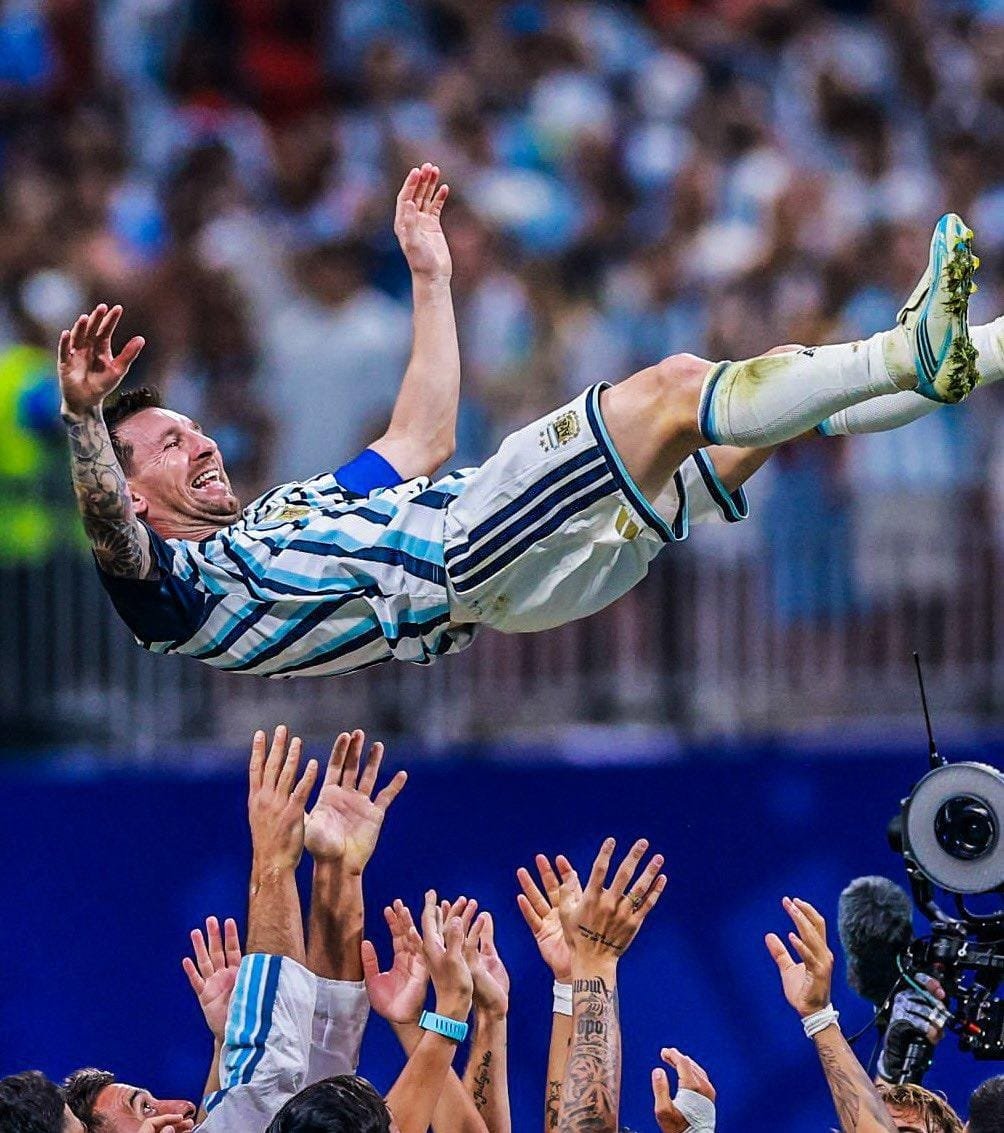

Lionel Messi has finally said goodbye to Argentina.
After more than two decades in the national colours, 207 appearances and 125 goals, the 39-year-old has confirmed his retirement from international football, bringing the extraordinary Argentina chapter of his career to an end.
Messi’s decision comes with a sense of finality this time. He had announced his international retirement once before, following Argentina’s defeat in the 2016 Copa América final, but returned to lead the country through one of the most successful periods in its football history.
His final appearance for Argentina came in the 2026 FIFA World Cup final, where La Albiceleste suffered a narrow 1-0 defeat to Spain on July 19. It was not the fairytale ending Messi would have wanted, but his contribution to Argentine football remains immeasurable.
With three major international trophies — the 2021 Copa América, 2022 FIFA World Cup and 2024 Copa América — Messi leaves the national team having finally delivered the silverware that had eluded him for much of his career.
Messi’s Argentina Career: The Numbers
Messi’s international record tells the story of an extraordinary career.
He made 207 appearances for Argentina, scoring 125 goals and providing 60 assists, meaning he was directly involved in 185 goals for his country.
His scoring record is dominated by his famous left foot. Of his 125 international goals, 111 came with his left foot, while 12 were scored with his right foot, two with his head and one with his torso.
He also leaves as Argentina’s undisputed all-time leading goalscorer.
Six World Cups, 34 Appearances
Messi’s longevity at the World Cup is another part of his remarkable legacy.
He appeared at six World Cups, more than any other player in men’s football history. Across those tournaments, he made a record 34 appearances, won 23 matches and registered 12 assists.
He scored 21 World Cup goals, although France star Kylian Mbappé moved ahead of him during the 2026 tournament with 22.
Messi also holds the record for most World Cup penalties scored, with seven, although he has missed three from the spot.
The Argentine became the first player to start three World Cup finals, doing so in 2014, 2022 and 2026. At 39 years and 25 days, he was also the oldest outfield player to appear in a World Cup final.
His six World Cup appearances are themselves a record.
A Record-Breaking Tournament Career
Messi’s influence was not limited to the World Cup.
He retires with 35 goals in major international tournaments, the most in men’s football history across the World Cup, Copa América, European Championship, Gold Cup, Africa Cup of Nations, Asian Cup and OFC Nations Cup.
For Argentina, he also scored 11 international hat-tricks, with his final treble coming in the opening match of the 2026 World Cup.
From a Difficult Debut to Argentina’s Greatest
Messi’s Argentina story began in extraordinary fashion.
He made his senior international debut on August 17, 2005, against Hungary. Introduced as a substitute, the teenage Messi was sent off less than a minute later after being adjudged to have elbowed Hungary defender Vilmos Vanczák.
Few could have imagined then that the young forward would go on to become the most important player in Argentina’s modern football history.
For years, however, his relationship with the national team was defined as much by disappointment as brilliance.
Argentina suffered defeats in major finals, and Messi faced relentless comparisons with Diego Maradona. The pressure became particularly intense after the 2014 World Cup final loss to Germany and the back-to-back Copa América final defeats in 2015 and 2016.
The 2016 disappointment prompted Messi’s first international retirement announcement.
But he returned.
And what followed changed everything.
Three Major Trophies Changed the Story
Messi’s Argentina legacy was transformed by the team’s triumph at the 2021 Copa América, where Argentina defeated Brazil in the final at the Maracanã.
A year later came the defining achievement of his career.
Messi captained Argentina to the 2022 FIFA World Cup title in Qatar, producing a tournament that cemented his place among the greatest players the sport has ever seen.
Argentina then added another Copa América crown in 2024, further establishing a golden era for the national team.
By the time Messi walked onto the field for his final World Cup campaign in 2026, the narrative had changed completely.
He was no longer the player desperately searching for international glory.
He was the captain who had already delivered it.
‘I Always Gave It My All’
Messi revealed that his decision had been made shortly after the 2026 World Cup final but that he waited before making it public.
In his farewell message, he reflected on his extraordinary journey with Argentina and insisted that he had always given everything for the national shirt.
He also acknowledged the emergence of a new generation of Argentine players who now have an opportunity to take the team forward.
That transition will not be easy.
For more than 20 years, Argentina’s attack, creativity and identity were built around Messi. His ability to produce a goal from nothing, unlock a defence with a single pass or take control of a match made him much more than just another player.
He was the team’s reference point.
Argentina After Messi
The biggest question now is what Argentina looks like without its No. 10.
The country has produced exceptional players throughout its history, but replacing Messi is not simply about finding another goalscorer.
Who replaces the player capable of carrying the ball through an entire defence?
Who supplies those passes that seem impossible until Messi makes them?
Who takes responsibility when a major match reaches its decisive moments?
Argentina will eventually find new stars. Football always does.
But there will only ever be one Messi.
His departure also marks the end of one of the defining individual eras in international football. The player who spent years being compared with Maradona ultimately created a legacy of his own — one built on records, trophies, extraordinary goals and an unparalleled connection with the Argentina shirt.
The End of an Era
Messi leaves international football as Argentina’s record appearance holder, record goalscorer and one of the most decorated players in the country’s history.
His final World Cup may not have ended with the trophy, but perhaps that is fitting in its own way. Football rarely provides perfect endings.
What matters is everything that came before it.
From that bizarre red card on his international debut in 2005 to lifting the World Cup in 2022, Messi’s Argentina journey was filled with heartbreak, criticism, redemption and ultimately glory.
For Argentina, the era of Lionel Messi is over.
But the memories will remain.
Celebrate Lionel Messi. Celebrate what he gave Argentina. Do not cry for Messi, Argentina — simply say thank you