
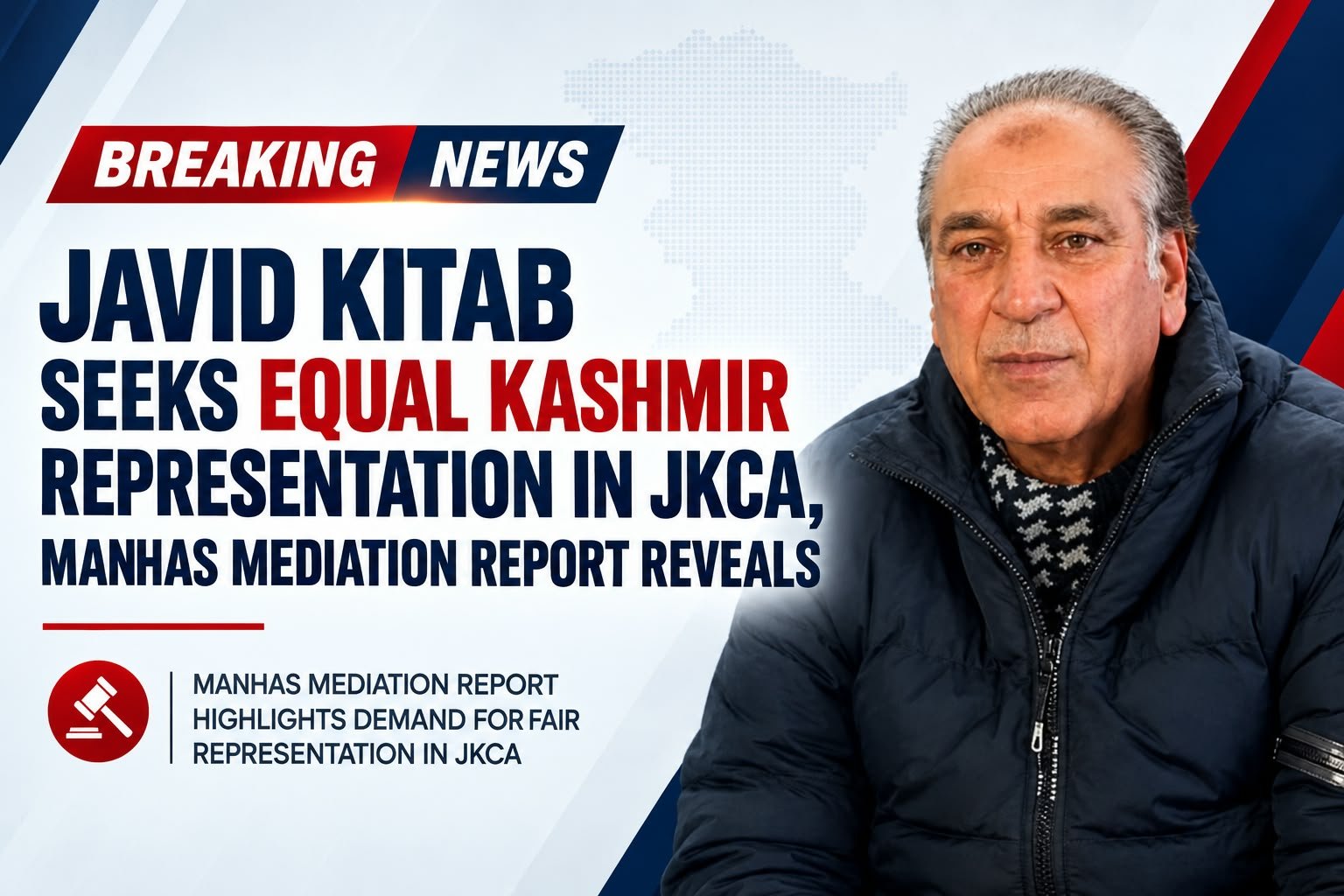

SRINAGAR: The prolonged dispute within the Jammu & Kashmir Cricket Association (JKCA) appears to have been narrowed considerably following court-directed mediation, with virtually all contentious issues reportedly finding common ground except one: the demand for equal regional representation between Jammu and Kashmir in appointments, selections and engagements within the association.
The mediation report submitted before the Court of the 2nd Additional District Judge, Srinagar, records that the parties participated in proceedings on three separate dates and that “considerable progress” was made towards resolving the dispute.
The mediation was undertaken pursuant to the court’s July 13, 2026 direction for an endeavour towards an amicable settlement in the case filed by Javid Ahmad Kitab, President of the JKCA, against Vivek Khajuria and others.
The report, dated September 26, 2026, identifies just one principal issue on which the parties could not reach agreement.
According to the mediator, BCCI President Mithun Manhas, Kitab insisted that appointments, engagements and selections within the JKCA—including players, coaches, support staff and other allied positions—should have equal distribution or representation between the Kashmir and Jammu divisions.
The opposing side, however, maintained that such appointments and selections should be based on merit, suitability and eligibility under the JKCA Constitution and governing framework, and that no predetermined regional allocation could be imposed.
The question of merit versus representation
At the heart of the disagreement is therefore not simply who gets selected, but whether merit and regional representation can coexist within the JKCA’s institutional structure.
Kitab’s position, as recorded in the mediation report, is that there should be parity between the two regions.
That demand assumes particular significance against the backdrop of repeated concerns in Kashmir over the composition of JKCA teams, coaching groups, support staff and other cricketing structures.
A demand for balanced representation does not necessarily mean that players or officials from either region should be selected irrespective of merit. Rather, the larger question is whether an association representing the entire Union Territory should ensure that opportunities, participation and institutional presence are not perceived to be concentrated overwhelmingly in one region.
That distinction is important.
If merit is the only criterion, then the JKCA must also be able to demonstrate that its selection and appointment mechanisms are transparent, objective and capable of producing genuinely balanced representation over time.
Recent Irani Cup example adds weight to the debate
The debate has acquired greater relevance following the recent Irani Cup encounter between J&K and Rest of India at the Sher-i-Kashmir Cricket Stadium in Srinagar, where questions were raised over the composition of the J&K support structure.
The J&K squad itself featured players from different parts of the Union Territory, but the perception among sections of Kashmir’s cricket fraternity was that the support staff and associated team structure had little or no meaningful representation from Kashmir.
For critics of the existing arrangement, this is precisely why Kitab’s demand for regional parity has become important.
The issue is not simply about one tournament or one appointment. It is about whether Kashmir’s cricketing ecosystem receives a proportionate voice and presence in an association that represents both Jammu and Kashmir.
The concern becomes even more significant when similar patterns are perceived across different teams, coaching structures and support positions.
Mediation report is significant for Kitab
The mediation report also gives an important perspective on Kitab’s legal battle. Rather than portraying the dispute as one in which every issue remains unresolved, the mediator has specifically recorded that substantial common ground was reached on almost all other aspects.
Paragraph 9 of the report goes further, stating that the regional representation issue “remains the principal unresolved issue and constitutes the core of the dispute.”
That is significant because it places the question of Kashmir-Jammu parity at the centre of the remaining disagreement.
Kitab has challenged his expulsion from the JKCA by the rival group and has continued to assert his position as the association’s President. The court subsequently directed the parties towards mediation, with Manhas undertaking the process. The mediator’s report now provides a written record of where the two sides stand.
A broader question for J&K cricket
The dispute therefore raises a question that extends beyond the personalities involved. Should regional balance have a place in the administration of cricket in Jammu and Kashmir?
J&K cricket has a long history of players emerging from both regions. Kashmir has produced established cricketers, coaches and officials, just as Jammu has. The JKCA’s responsibility, therefore, is not merely to conduct matches but to create an institutional structure in which talent from across the Union Territory feels equally represented.
The argument for parity becomes particularly compelling when the issue concerns appointments and support structures rather than purely performance-based player selection.
A player who scores runs or takes wickets can be judged statistically. But when it comes to coaches, support staff, administrators, selectors and other engagements, questions of representation, transparency and institutional opportunity inevitably arise.
There is also a practical reason for ensuring wider representation.
An association that draws talent from the entire Union Territory benefits when its decision-making and support structures reflect that diversity. It can strengthen confidence among players, coaches and cricket stakeholders and reduce perceptions of regional exclusion.
The unresolved issue is now clearly on record
The mediation report does not declare either side right or wrong. It records their respective positions.
But it does something equally important: it places the regional representation question firmly on the judicial record as the principal unresolved issue.
Manhas has recorded that the parties made substantial progress and that sincere efforts were made towards an amicable settlement.
Yet, after three rounds of discussions, the issue of equal representation between Jammu and Kashmir remained unresolved.
For Kitab, that could be seen as a vindication of his decision to keep the question alive.
His demand is no longer merely a political or administrative argument within the JKCA. As recorded by the court-appointed mediation process, it is the single major issue separating the parties after substantial progress on other matters. The next question, therefore, is not simply who controls the JKCA.
It is whether the association can evolve an administrative framework in which merit is protected, while regional parity and equal institutional opportunity are also guaranteed.
For Kashmir’s cricket fraternity, that question may prove to be far more consequential than the current dispute between individuals.
Because ultimately, the issue is not Jammu versus Kashmir. It is whether both can have an equal stake in the future of J&K cricket.