
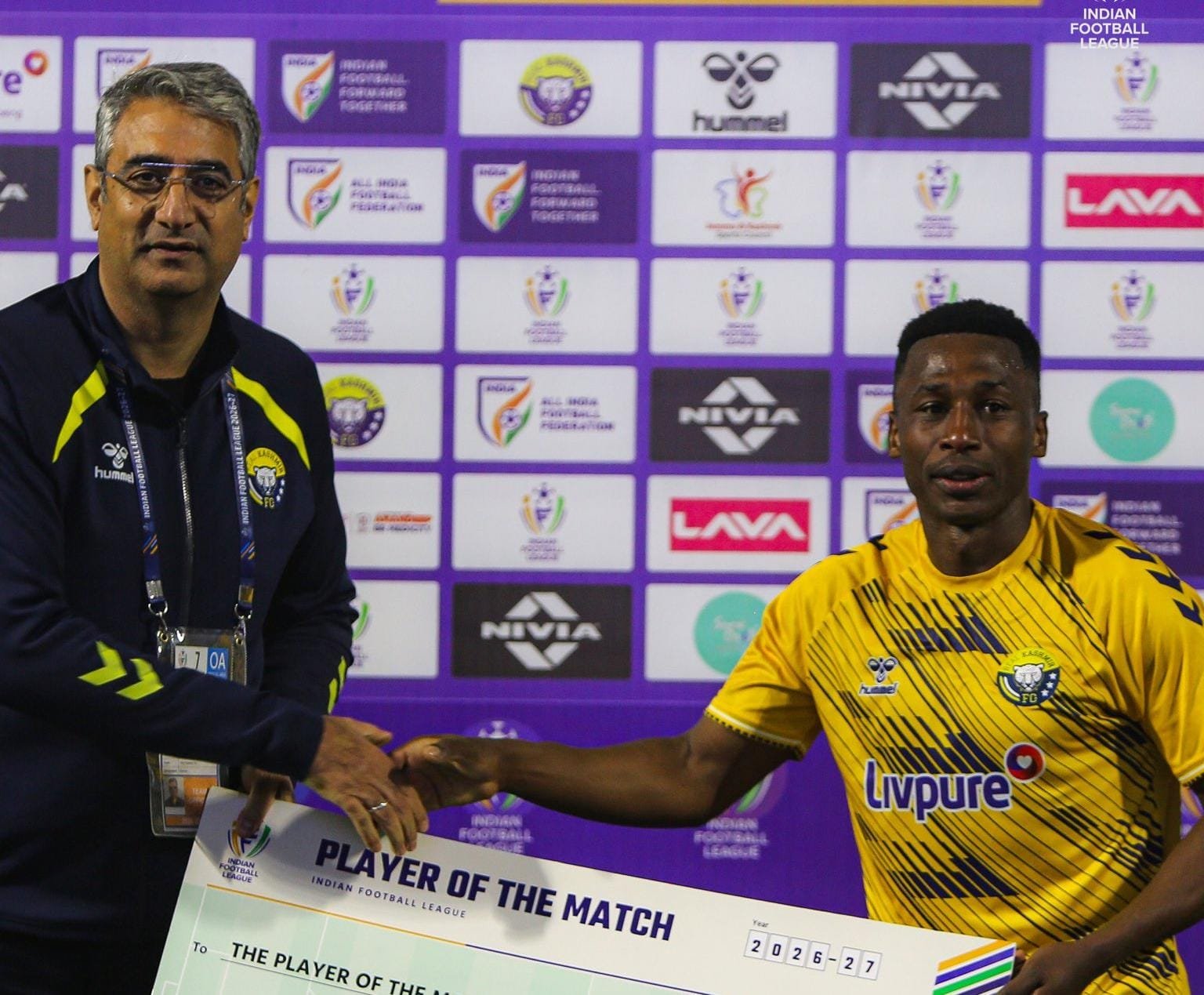

Srinagar, Nov 7: Real Kashmir FC’s downward slide shows little sign of stopping, with the club’s latest 1-1 draw against Sreenidi Deccan FC at the TRC Ground on Saturday raising further questions about its direction, ambitions and management under the new ownership.
Once regarded as one of the more competitive sides in Indian domestic football, the Snow Leopards are increasingly struggling to reproduce the performances that made them a formidable presence in the I-League. Their transition into the Indian Football League (IFL) has so far failed to bring about the revival many had expected.
Saturday’s draw against Sreenidi Deccan came after a humiliating defeat against Nagaland United FC in their opening match last week, leaving Real Kashmir with just one point from their first two home outings. With one defeat and one draw, the Srinagar-based club have collected only one of the six points available so far.
While the season is still in its early stages, the results are beginning to resemble the troubling pattern witnessed last season, when Real Kashmir struggled throughout the campaign and found themselves battling for survival in the second phase after finishing among the bottom teams in the main round. The club eventually managed to avoid relegation, but its performances offered little reassurance about its long-term direction.
The concern now is that the problems which undermined the previous campaign have not been adequately addressed.
From I-League contenders to a struggling outfit
Only a few seasons ago, Real Kashmir FC were a force to reckon with in the I-League. The club had established itself as a competitive outfit capable of challenging some of Indian football’s established heavyweights, earning recognition for its performances and the identity it built around representing Kashmir on the national stage.
However, the changing landscape of Indian football, with several prominent clubs moving into the Indian Super League, has altered the competitive equation. Yet, even within the changed structure of the domestic game, Real Kashmir have failed to move forward.
Instead of capitalising on the opportunity to strengthen their position and rebuild a competitive squad, the club’s performances have followed a worrying downward trajectory.
The transition from being genuine contenders to struggling for consistency and survival has been particularly concerning for a club that once carried considerable expectations among football followers in Kashmir.
New ownership, but where is the revival?
A change in ownership often brings fresh investment, new ideas and a renewed sporting vision. In football, such transitions can either take a club forward or push it into a period of uncertainty, depending on the priorities and competence of those running it.
In Real Kashmir’s case, the change of ownership has yet to translate into a visible improvement on the field.
There are growing questions about whether sufficient attention is being given to the club’s footballing requirements, long-term planning and competitive ambitions. Promotional visibility and public appearances may help build a brand, but they cannot replace investment in the squad, a clear footballing philosophy and accountability for results.
The primary responsibility of a football club’s ownership should be to build a competitive team, establish a sustainable sporting structure and create an environment in which players and coaches can deliver results.
For Real Kashmir, the immediate concern is that there appears to be no convincing turnaround despite the change in ownership. The club’s recent performances suggest that the fundamental issues affecting its competitiveness remain unresolved.
Coaching continuity without convincing results
Another issue that deserves scrutiny is the continuity of the coaching and management setup despite the club’s disappointing performances.
Continuity can be valuable in football, but it must be supported by progress, tactical improvement and results. Retaining the same structure without addressing recurring shortcomings risks turning continuity into stagnation.
After a difficult previous campaign, questions should have been asked about the team’s tactical approach, recruitment, squad balance and overall performance. The latest results suggest that those concerns have not disappeared.
Real Kashmir need more than routine changes or assurances. They need a clearly defined sporting strategy, stronger recruitment and a coaching setup capable of taking the team forward.
A Kashmir club without a strong Kashmiri core
Perhaps the most significant concern surrounding Real Kashmir FC is its failure to establish a strong local identity within the playing squad.
Despite carrying Kashmir in its name and representing the region in national competitions, the club’s first-team composition continues to rely heavily on players recruited from outside Jammu and Kashmir.
Recruiting players from across the country is a normal and necessary part of professional football. However, for a club that emerged from Kashmir and has enjoyed considerable regional support, developing local footballers should have been an equally important part of its sporting philosophy.
Real Kashmir have yet to establish a convincing record of developing and promoting homegrown players into the senior team. The absence of a visible pathway from local football to the first team raises questions about the club’s grassroots vision and its commitment to nurturing talent from the region.
A successful football club should not only compete in national tournaments but also contribute to the development of the sport in the region it represents.
For Real Kashmir, that responsibility should mean investing in youth development, strengthening scouting networks across Jammu and Kashmir and providing genuine opportunities to talented local footballers.
Without such a vision, the club risks becoming a team based in Kashmir rather than a team that truly represents the footballing aspirations of Kashmir.
Saturday’s draw reflects the larger problem
Against Sreenidi Deccan, Real Kashmir showed attacking intent and took the lead before the visitors restored parity in the second half.
The Snow Leopards had opportunities to reclaim the advantage and pushed forward in search of a winner, but their inability to convert chances into goals ultimately cost them two valuable points.
Playing under floodlights at the TRC Ground, the home side also enjoyed considerable support from spectators despite the cold weather. Yet, the result offered little comfort to supporters hoping for a convincing response following the opening-match defeat.
A draw in isolation would not necessarily be a major setback. However, when viewed against last season’s struggles, the opening defeat against Nagaland United and the club’s broader decline, it becomes another indication of the challenges facing the team.
Real Kashmir FC once represented a remarkable footballing story from Kashmir, rising through the national football structure and establishing itself among the country’s competitive clubs.
That story now needs a new chapter, but it will not be written through branding, publicity or symbolic changes in ownership.
It requires serious football administration, accountability, better recruitment, a settled sporting vision and, most importantly, a genuine commitment to developing Kashmiri footballers.
The question facing the new ownership is straightforward: is Real Kashmir FC being run with the ambition of becoming a competitive force in Indian football again, or is the club gradually losing the identity and sporting standards that made it special in the first place?
For now, the results are offering little reason for optimism.