
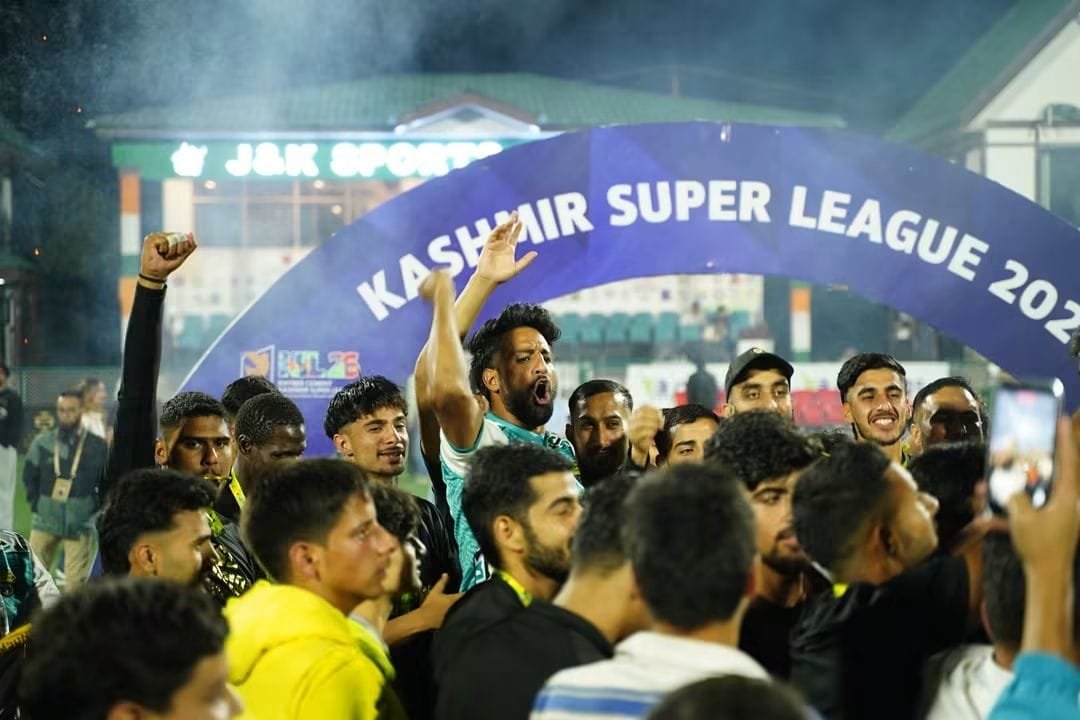

Srinagar: The second edition of the Kashmir Super League (KSL) Football has once again demonstrated that Kashmir has the appetite, talent and audience for a professionally organised football competition. Aqua Kashmir Avengers lifted the KSL 2026 title after defeating Athwas India FC in the final at TRC Ground, Srinagar, bringing another successful edition of the competition to a close.
Credit must go where it is due.
Fucan Sports, the private organisation behind KSL, deserves appreciation for creating an event that brought teams, players, officials, volunteers and football followers together under one organised structure. From match operations to officiating, logistics and presentation, the tournament demonstrated that a professionally managed football competition can generate considerable interest in Kashmir.
But amid all the fanfare surrounding KSL, one uncomfortable question cannot be ignored:
What happened to DFA Srinagar?
KSL Was Running. DFA Srinagar Was Not.
While KSL was being played with considerable visibility, the regular football activities under the District Football Association (DFA) Srinagar remained largely paralysed.
These are not insignificant competitions.
DFA Srinagar’s traditional football calendar includes the Premier League, Super League — previously known as the A Division — and A Division League, earlier known as the B Division.
These competitions form an important part of the local football pyramid and provide opportunities to hundreds of players and dozens of clubs.
Yet during the period when KSL was attracting attention, these established DFA competitions were conspicuous by their absence.
That raises a legitimate question:
Why should the activities catering to hundreds of teams and thousands of players be stopped or remain inactive while a private league involving only a handful of teams is being conducted successfully?
The question is not about competing with KSL. It is about the responsibility of the established football administration.
KSL Did What Others Have Struggled to Do
There is another important aspect that deserves recognition. KSL did not appear to depend on the traditional DFA structure to function. The organisers created their own organising mechanism, arranged their own operational structure, appointed volunteers and officials, and, in several cases, brought match officials from outside J&K. In simple terms, KSL largely ran through its own internal system. That is precisely why its success should be examined seriously.
A private organisation has demonstrated that it is possible to create a competitive football event, attract spectators, organise matches and generate a football atmosphere in Srinagar.
For years, the football administration has spoken about the need to strengthen the sport, create proper leagues and develop a sustainable competition structure. KSL has now provided a practical example of what professional organisation can look like. It has, in many respects, done what the established football structures have struggled to do consistently. That should not be seen as a threat. It should be seen as a lesson.
Was Ground Really the Problem?
One possible explanation for inactivity in local football is often the availability of grounds. But that argument does not appear convincing in this case. KSL itself primarily used TRC Ground. At the same time, football facilities such as the Polo Ground Centre, Polo Ground Rugby Ground and Gindun Ground were available for conducting local competitions. So the obvious question remains. If grounds were available, why were DFA Srinagar’s regular competitions not taking place?
Where were the Premier League fixtures?
Where was the Super League?
Where was the A Division competition?
And where was the broader football calendar that should keep hundreds of players and clubs engaged? These are not unreasonable questions. They are questions that the football community deserves answers to.
The Bigger Concern:
DFA Srinagar’s Structure The issue goes beyond competitions. It is also about the organisational structure of DFA Srinagar. The association’s Secretary resigned more than two years ago, and, according to the situation described within the association, the position has remained unfilled since then. If a key constitutional or organisational post becomes vacant, there should ordinarily be a mechanism to fill it within the prescribed framework and within a reasonable period. Yet two years is a very long time.
During this period, the President and Treasurer have continued to shoulder the functioning of the association while the vacant Secretary’s position has not been filled.
The football community therefore has every right to ask:
Why has there been no election or appointment to fill the vacant position? And perhaps more importantly: Why has the issue been allowed to continue for so long? This is not simply about individuals. It is about institutional functioning.
An association representing a major football district cannot afford to operate indefinitely with important positions vacant and without a clearly functioning organisational structure. Two People Cannot Be the Entire Football System Srinagar is not a small football district. It has a large network of clubs, academies, players, coaches, referees and football supporters. The district has historically been one of the principal centres of football in Kashmir. Its football administration therefore requires a functioning structure with accountability, representation and regular competition. When an association effectively operates around a very small number of office-bearers for an extended period, questions about representation and institutional accountability naturally arise. The issue becomes even more serious when the association’s own competitions and developmental activities are not taking place. The football fraternity deserves more than occasional appearances at high-profile events.
Where Is JKFA?
The DFA Srinagar question cannot be separated from the larger crisis surrounding the J&K Football Association (JKFA).
For years, football in J&K has remained affected by legal and internal disputes, leaving the sport without the kind of effective central administration that should provide direction and oversight to district associations.
The absence of a properly functioning central football body has consequences.
Without an effective JKFA structure, there is limited central coordination, limited institutional review and limited accountability for the functioning of district associations. That vacuum can ultimately affect the grassroots game.
DFA Srinagar, being one of the most important district football bodies in the region, needs an effective central framework to operate within.
Instead, the continuing absence of a fully functional JKFA has created a situation in which district-level football administration can continue without the level of scrutiny and coordination that a healthy sporting system requires.
KSL Should Not Be the Exception
Perhaps the biggest lesson from KSL is not that private organisations can organise football. We already know they can. The real lesson is that Kashmir has the players, the audience, the grounds and the enthusiasm for football.
What is required is consistent organisation.
KSL has shown that when somebody takes responsibility and puts a functioning system in place, football can attract attention and generate excitement. The question is why this energy cannot be converted into a permanent football calendar.
Why should players wait months for meaningful competition?
Why should a district with such a strong football tradition not have a properly structured league system running throughout the year? .And why should the absence of a functioning central association continue to be accepted as normal?
Time for Answers — and Elections
This is not an argument against KSL.
Quite the opposite.
KSL deserves praise.
It has created a successful football product, provided players with competition and given supporters something to follow.
But its success makes the inactivity of the established football administration even more difficult to ignore.
If a private organisation can create a successful competition using its own organisational mechanism, there is no reason why the established football bodies should not be able to conduct their own regular leagues.
DFA Srinagar needs to answer the questions surrounding its inactive competitions, vacant organisational positions and overall functioning.
And above DFA Srinagar stands an even bigger requirement:
J&K needs a properly functioning, representative and accountable JKFA. The solution cannot be indefinite administrative paralysis. The football community needs a functioning central body, and that means resolving the existing disputes and moving towards a transparent process for JKFA elections. Football cannot develop on promises alone. It develops when players play, clubs compete, leagues operate and administrators remain accountable.
KSL has shown what is possible.
Now the established football administration must show that it has understood the lesson. Kashmir does not lack football talent. It does not lack football fans. It does not necessarily lack grounds. What it has lacked is continuity, structure and accountable administration. That is the real challenge facing football in Srinagar — and it is one that can no longer be ignored.