
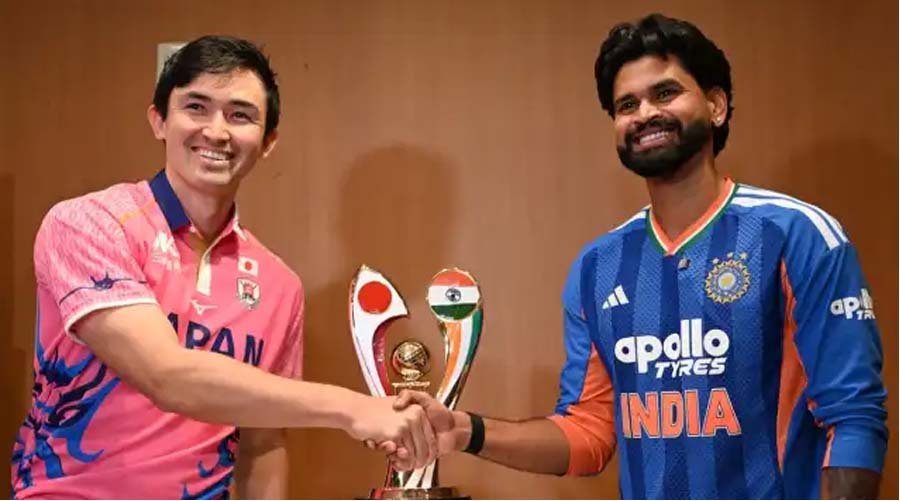

Sano, Japan: Rain and a possible typhoon threat could disrupt the much-anticipated India-Japan cricket clash on Tuesday, but the landmark fixture has already given Japanese cricket an unprecedented moment in the spotlight.
India are set to face Japan at the Sano International Cricket Ground, around 100 kilometres from Tokyo, in a match that carries significance far beyond the result.
For Japan’s players, the opportunity to share the field with the reigning T20 World Cup champions represents a landmark moment in the country’s cricketing journey. India, meanwhile, are using the fixture as part of their preparations ahead of their Asian Games campaign in Aichi-Nagoya.
The match also forms part of celebrations marking 75 years of diplomatic relations between India and Japan.
From Yokohama to Sano
Cricket has a surprisingly long history in Japan. According to archives of the Yokohama Country and Athletic Club, the first documented cricket match on Japanese soil was played in Yokohama on June 25, 1863.
The story surrounding that game has become part of Japanese cricket folklore. British merchants and Royal Navy sailors were reportedly involved in the match at a time when local merchants feared a possible samurai attack. The anticipated confrontation never materialised, but the cricket match went ahead.
More than 160 years later, the sport is attempting to establish a much stronger presence in Japan, where baseball remains overwhelmingly popular.
Japan cricket gets its biggest stage
The gulf between the two teams is considerable on paper. India are among the world’s leading cricket nations, while Japan are ranked 41st in the men’s T20I rankings.
The financial contrast is equally striking. The Japan Cricket Association operates with an annual budget of around USD 2 million, while India’s T20 captain Shreyas Iyer’s reported 2026 IPL salary was USD 3.15 million.
But for Japanese cricket, the significance of Tuesday’s game cannot be measured in rankings or finances.
Japan Cricket Association chief operating officer Alan Curr said the fixture itself represents a major breakthrough for the sport.
“A lot of the success has almost already happened. The fact that India has agreed to come, the fact that I’m sitting here talking to you guys, that there’s already a lot of Japanese media coming tomorrow to find out more about this game and about the sport — I think success is already here,” Curr said.
The increased attention comes at an important time, with cricket also featuring at the Asian Games, providing another opportunity to introduce the sport to a wider Japanese audience.
Japan’s players ready for the challenge
Japan’s squad also reflects the country’s evolving cricket landscape. Captain Kendel Kadowaki-Fleming, the team’s leading T20I run-scorer, has Australian heritage, as does his brother Alester. Declan Suzuki-McComb is another player with Australian lineage.
Off-spinner Ibrahim Takahashi has a Pakistani connection, with his father originally from Islamabad.
However, Japan’s cricket development is not solely dependent on the South Asian diaspora. The majority of players involved in the national setup are native Japanese, an important factor in the country’s long-term efforts to establish the sport.
Kadowaki-Fleming will lead Japan in what could become one of the most memorable matches in the country’s cricket history.
The Japanese side has also made selection decisions with the upcoming Asian Games in mind. Players who are eligible for T20 internationals under ICC regulations but do not meet the Asian Games eligibility requirements have been left out.
Japan determined to compete, not just participate
Despite the enormous difference in experience and resources, Kadowaki-Fleming insists Japan do not intend to treat the occasion as merely a ceremonial appearance.
“As exciting as the occasion will be of playing India, we’re not there to just celebrate the occasion. We’re there to show what we can do as a men’s team,” he said.
The Sano International Cricket Ground, which has a capacity of around 2,000 spectators and is also used for baseball, is expected to draw considerable attention for the fixture.
The weather, however, could have the final say. With a typhoon threat and rain forecast around the region, there is uncertainty over whether the historic contest will get underway.
Even if weather prevents a full game, India’s visit has already provided Japanese cricket with a rare opportunity to step into the national sporting spotlight.
For a sport that has spent more than a century and a half on the fringes of Japanese sporting culture, the India fixture could prove to be an important chapter in its effort to move closer to the mainstream.