
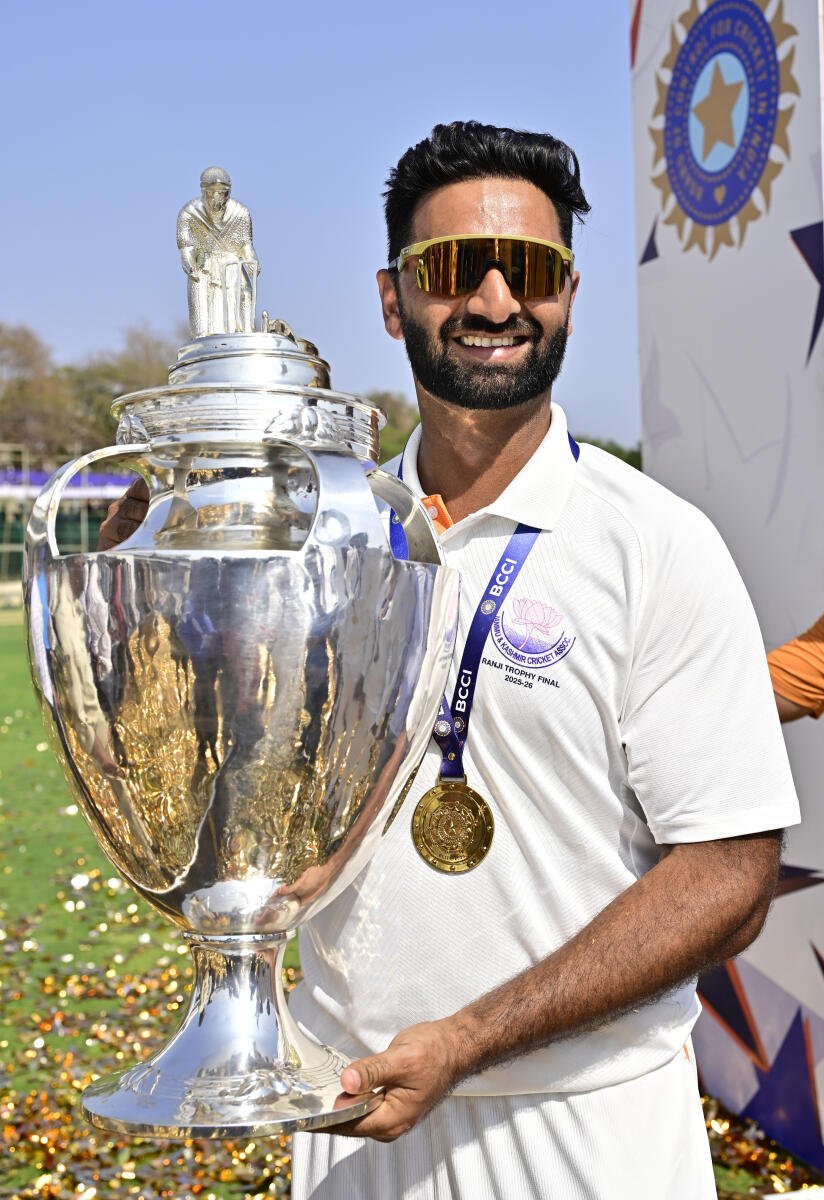

Jammu & Kashmir’s historic Ranji Trophy triumph in 2025-26 was built on a bowling attack that repeatedly found a way to rescue them. At the centre of it was Auqib Nabi. Now, for the first time since that title-winning campaign, J&K will have to find a way without him.
J&K take on Rest of India in the Irani Cup from October 1 to 5 at the Sher-e-Kashmir Stadium in Srinagar, with Auqib away on national duty. The right-arm pace-bowling all-rounder is part of India’s squad for the three-match ODI series against West Indies, which begins on September 27 and runs until October 3.
His absence leaves a sizeable hole in a J&K side that will also be without Yudhvir Singh, another player who made an impact with both bat and ball during their title-winning Ranji campaign. Yudhvir is currently injured and at the BCCI’s Centre of Excellence.
Auqib was not simply another member of J&K’s attack. He was its biggest weapon. He finished the 2025-26 Ranji Trophy season with 60 wickets in 10 matches and was particularly influential in the knockout stages, producing match-winning spells when J&K needed them most. His ability to contribute with the bat also gave the side an extra layer of depth. His absence will therefore be felt in both departments, but it is the pace attack where J&K appear most stretched.
Sunil Kumar, who operated as Auqib’s deputy through much of the campaign, remains an important part of the attack. Umar Nazir brings experience, but J&K may have to turn to Nasir Lone, Waseem Bashir or both to complete the seam-bowling unit. Both have considerably less experience at this level than Auqib. That could be particularly significant against a Rest of India side led by Rishabh Pant and packed with players who have played for India and at the highest level of domestic cricket.
J&K will at least have home conditions on their side. The pitch at the Sher-e-Kashmir Stadium is expected to offer assistance to the seamers, and a green surface would give their depleted pace attack something to work with. But a green pitch is no guarantee of success.
J&K discovered that last season when Mumbai beat them at home despite conditions that offered plenty of encouragement to the fast bowlers. The surface also has enough in it for good batting, meaning J&K cannot afford to rely entirely on their seamers. That is another concern.
Their batting was inconsistent throughout the Ranji Trophy campaign and, barring the final, often left the bowlers with little margin for error. They will need significantly more from their top order against a Rest of India attack if they are to stay in the contest. The Ranji Trophy title proved that J&K can compete with the best in domestic cricket. The Irani Cup, however, presents a different challenge.
Without the man who so often pulled them out of trouble last season, J&K will have to find out whether their success was built around one exceptional player or whether they have developed enough depth to withstand his absence. For a side returning to the Sher-e-Kashmir Stadium as Ranji Trophy champions, the Irani Cup is an opportunity to answer that question.