

SRINAGAR: Kashmir’s rapidly growing local cricket circuit is facing questions over scheduling, player workload and coordination among tournament organisers after a team qualified for two major finals scheduled to be played on the same day at different venues.
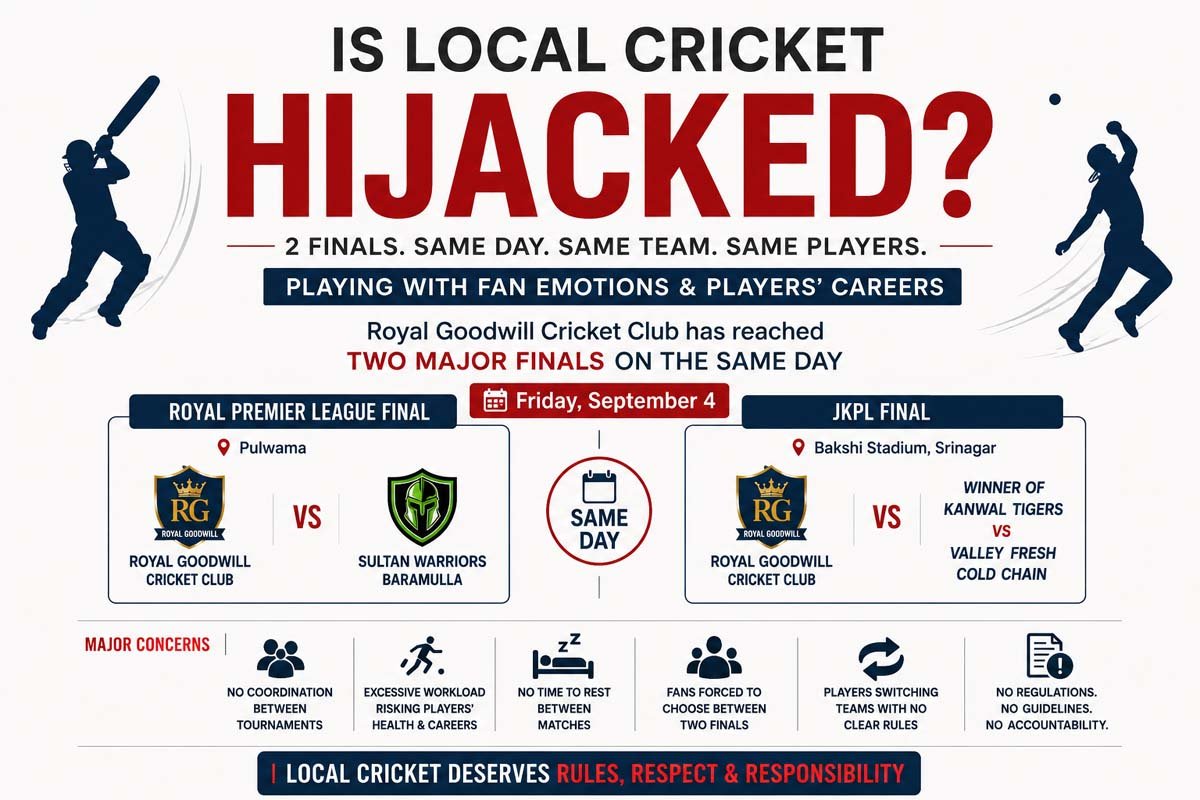
The unusual situation involves Royal Goodwill Cricket Club, which has reached the final of the ongoing Royal Premier League (RPL) in Pulwama as well as the final of the JKPL at Bakshi Stadium, Srinagar.
Both finals are scheduled for Friday, September 4, raising concerns over how the team and its players will manage the demanding schedule.
In the RPL final at Pulwama, Royal Goodwill are scheduled to face Sultan Warriors Baramulla, while in the JKPL final at Bakshi Stadium, they will take on the winner of the semi-final between Kanwal Tigers and Valley Fresh Cold Chain.
The scheduling has raised eyebrows among followers of local cricket, particularly because the two venues are located in different districts and the team could potentially be required to play two high-pressure finals on the same day.
Questions over coordination
The development has brought renewed attention to the absence of a coordinated framework governing Kashmir’s expanding local cricket competitions.
With several leagues being organised across the Valley, the same teams and players are frequently seen participating in multiple tournaments. While participation in different competitions is not necessarily a problem in itself, the lack of uniform regulations regarding player registrations, transfers, eligibility and workload has become a matter of concern.
There is currently no widely established central system through which tournament organisers can coordinate player availability and ensure that major fixtures do not clash for the same teams.
The situation involving Royal Goodwill has therefore highlighted what many believe is a need for greater coordination between organisers.
Player welfare a major concern
The issue is particularly significant from the perspective of player welfare.
Local cricketers often participate in several competitions during the season, with tournament cricket providing an important opportunity for players to remain active and earn from the sport.
However, playing multiple matches in quick succession, particularly high-intensity knockout games, can increase physical fatigue and the risk of injury.
The concern becomes even greater when players are required to travel between venues and compete with little recovery time.
Unlike professional domestic or international cricket, where player workload, recovery and scheduling are closely monitored, local tournaments often operate independently of one another.
The absence of minimum recovery guidelines could potentially put unnecessary physical pressure on players who are already playing a heavy schedule.
Semi-final followed by final
Another concern has emerged around the JKPL schedule itself.
The semi-final at Bakshi Stadium is being played late on Thursday night, with the finalist expected to feature in the final the following day.
If the semi-final extends late into the night, the winning side could have only a limited period to recover before returning for the championship match.
For a tournament at this level, such scheduling raises questions about competitive balance and whether teams are being given adequate time to prepare and recover between knockout matches.
Fans caught in the middle
The scheduling also creates difficulties for cricket fans.
Supporters who regularly travel to different districts to watch local cricket could be forced to choose between two major finals involving the same team.
Local cricket has grown largely because of the enthusiasm of its supporters, many of whom travel significant distances to attend matches.
As the popularity of these tournaments continues to increase, organisers may need to give greater consideration to spectators while preparing their schedules.
Same players, different leagues
Another issue that deserves attention is the repeated appearance of similar groups of players across different local tournaments.
Players moving between teams and competitions is common in local cricket, but without transparent and consistent rules, it can create confusion over eligibility and team composition.
A properly structured system could include centralised player registration, clearly defined transfer windows, eligibility rules and restrictions on representing multiple teams within overlapping competitions.
Such measures would not only improve transparency but could also help protect the credibility of local tournaments.
Time for a common framework?
Kashmir’s local cricket has grown significantly in recent years, with numerous tournaments providing platforms for talented cricketers who otherwise have limited opportunities to showcase themselves.
The growth itself is welcome.
However, the expansion of local cricket also brings greater responsibility for tournament organisers.
There is now a strong case for developing a common framework for local competitions covering player registration, eligibility, transfers, scheduling, workload management, rest periods and coordination between tournaments.
A central database of registered players could also help organisers identify scheduling conflicts and prevent situations where the same players are required to play at different venues within an impractical timeframe.
The objective should not be to restrict local cricket or reduce the number of tournaments. Rather, the aim should be to make competitions more organised, transparent and player-friendly.
The Royal Goodwill situation has simply brought the larger issue into focus.
Kashmir’s local cricket is no longer a small recreational activity. It has become a major part of the region’s sporting culture, attracting players, spectators and significant public interest.
With that growth comes the need for professionalism.
More leagues may mean more opportunities, but without coordination and proper regulation, the same growth could eventually come at the cost of player welfare, competitive fairness and the credibility of the game.