
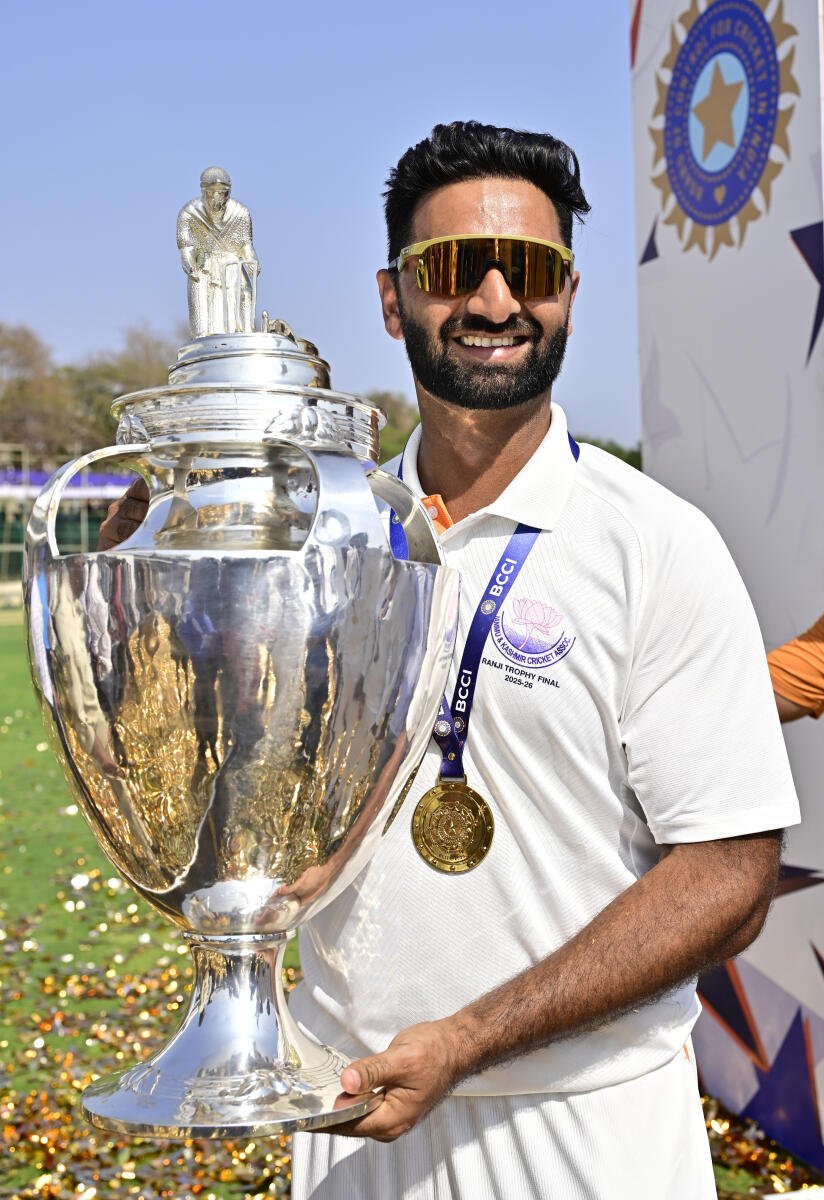

For decades, cricket in Jammu & Kashmir lived in the shadows of Indian domestic giants. Talent existed, passion ran deep, but the pathway to greatness seemed distant. Infrastructure was limited, opportunities were rare, and belief itself often struggled to survive in a region where sport had to compete with far greater challenges.
Then came a season that changed everything.
In the winter of 2026, Jammu & Kashmir scripted the greatest chapter in its cricketing history by lifting the Ranji Trophy for the first time. It was a triumph that stunned the domestic circuit, shook traditional powerhouses and ignited a new era of sporting belief in the northernmost corner of India.
But while the celebrations continue and the glory of this historic achievement is being savoured across the region, it is important to remember that J&K’s rise in cricket did not happen overnight.
Much like the saying that Rome was not built in a day, the story of cricket in Jammu & Kashmir is one of patience, struggle and perseverance. The success that the team enjoys today stands on foundations built over decades — by players, coaches and mentors who invested their time and energy when the spotlight rarely reached the Valley.
In recent days, many within the Jammu & Kashmir Cricket Association have basked in the glory of the triumph, with several officials receiving praise largely because of their current positions. Yet the truth is that the development of cricket in the region has been shaped by far deeper and more meaningful contributions.
Among the individuals who played defining roles in nurturing cricket in Jammu & Kashmir are stalwarts such as Bishan Singh Bedi, who once mentored the state team with remarkable dedication, former India all-rounder Irfan Pathan, who spent considerable time working with young cricketers in the region, and J&K’s own trailblazer Parvez Rasool, whose rise to the Indian team inspired an entire generation. Former domestic stalwart Mithun Manhas also played a crucial role in shaping the state side and instilling professionalism within the dressing room.
Their efforts built the ecosystem that has finally produced a historic outcome.
Yet amidst all the narratives surrounding the team’s success, one undeniable truth stands out — Jammu & Kashmir’s maiden Ranji Trophy triumph was powered by the extraordinary season of one man.
Auqib Nabi.
The Making of a Champion
Auqib Nabi’s journey began far from the glamour of major stadiums. In the quiet village of Sheeri in Baramulla district, cricket was played on dusty patches of land where proper pitches were almost unheard of.
His father, Ghulam Nabi Dar, a government school teacher, initially hoped his son would pursue academics and enter the medical profession. Like many families in the region, stability mattered more than sporting dreams.
But the young Auqib was relentless.
Shy, introverted and quietly determined, he continued to play cricket whenever he could, often sneaking away to play matches with friends. Even when scolded or discouraged, he never argued — but he never gave up either.
Eventually, his father realised that cricket was not just a pastime for his son.
It was his calling.
The Long Road from Baramulla
The early years were anything but easy.
Facilities were scarce and aspiring cricketers often had to travel long distances to find proper training grounds. Nabi regularly travelled nearly 60 kilometres from Baramulla to Srinagar just to access decent practice facilities.
Sometimes friends offered him rides. Sometimes local bus drivers refused to take his fare.
The journey itself became part of his training.
Trial rejections came as well. Nabi failed to make the state team in his first two attempts, but he returned again and again until he finally secured a place on the third try.
Those setbacks only strengthened his resolve.
The Turning Point
When Nabi first entered the senior state side, he possessed natural ability — a strong wrist position, rhythm in his run-up and the natural ability to swing the ball away from right-handers.
But his bowling lacked variety.
That changed when bowling coach P. Krishna Kumar began working closely with him. Together they refined his technique, improved his wrist position and taught him how to swing the ball both ways.
Soon, Nabi’s deliveries began to move late — often deceiving even the most experienced batsmen.
Suddenly, he was no longer just another promising seamer.
He had become a genuine match-winner.
The Season of a Lifetime
The 2025–26 Ranji Trophy season transformed Auqib Nabi into the most feared fast bowler in domestic cricket.
He finished the tournament as the leading wicket-taker with 60 wickets, one of the highest tallies ever recorded by a fast bowler in a Ranji Trophy season.
His numbers bordered on historic:
- 60 wickets in the Ranji Trophy season
- 104 wickets across two consecutive Ranji seasons
- 13 five-wicket hauls in just 18 matches
- Average of just over 13 runs per wicket
- 95 wickets across all domestic formats in the season
For a fast bowler operating largely on Indian pitches that rarely favour seam bowling, those figures were extraordinary.
Yet the real impact of Nabi’s season was not merely statistical.
It was decisive.
The Knockout Specialist
When the tournament reached its most crucial stage, Nabi elevated his performances even further.
In the knockout rounds, he single-handedly dismantled some of the strongest batting line-ups in domestic cricket.
- 12 wickets in the quarterfinal against Madhya Pradesh
- 9 wickets in the semifinal against Bengal
- 5 wickets in the final against Karnataka
In total, he claimed 26 wickets in the knockout stage alone, carrying Jammu & Kashmir to the title almost single-handedly.
The final against Karnataka perfectly illustrated his impact.
Facing a lineup featuring international stars like KL Rahul, Mayank Agarwal and Karun Nair, Nabi delivered yet another devastating spell. His wickets broke the backbone of Karnataka’s batting and ensured J&K maintained a commanding advantage.
It was the defining performance of a defining season.
The Grind Behind the Glory
While the world now celebrates his achievements, very few recognise the grind that preceded them.
Ironically, just two years earlier, the same system that now applauds Nabi had overlooked him. Despite consistent performances, he was kept out of the team at times — a reminder of how unpredictable the journey of a cricketer can be.
His development also included formative experiences such as training camps conducted by Irfan Pathan in Srinagar during 2017–18. Those camps offered young cricketers like Nabi exposure to international-level guidance and helped shape their belief in their own abilities.
The seeds planted during those years eventually blossomed into something extraordinary.
More Than Just a Bowler
While his bowling dominated headlines, Nabi also proved his value as a lower-order batsman.
In a Vijay Hazare Trophy match, he stunned observers with an unbeaten 114 while batting at No. 8, sharing a record 182-run partnership for the eighth wicket.
It was one of the highest scores ever recorded by an Indian batting so low in the order in List A cricket.
The innings demonstrated that he was far more than just a tailender.
The IPL Recognition
Success inevitably attracts attention.
During the IPL auction, a bidding war erupted before Delhi Capitals secured Nabi for ₹8.4 crore, a remarkable rise for a player who had previously gone unnoticed in auctions.
For his family, it was the moment when years of belief finally paid off.
Before the auction, Nabi had quietly reassured his worried mother.
“One day,” he told her, “teams will bid crores for your son.”
He kept that promise.
The Calm Warrior
Despite his achievements, Nabi remains one of the quietest figures in the dressing room.
He speaks little, avoids the spotlight and prefers to let his performances define him.
But when Jammu & Kashmir need a breakthrough, there is only one bowler the captain turns to.
Auqib Nabi.
Time and again, he has delivered.
The Legacy of a Season
Jammu & Kashmir’s Ranji Trophy triumph represents far more than a single season’s success.
It marks the culmination of decades of effort — from mentors like Bishan Singh Bedi to pioneers like Parvez Rasool who inspired the next generation.
But in the story of this historic victory, one name will forever stand tallest.
Auqib Nabi.
From the dusty fields of Baramulla to the pinnacle of India’s domestic cricket, his journey is a testament to resilience, belief and relentless hard work.
For Jammu & Kashmir, the Ranji Trophy win will always be remembered as a collective triumph.
Yet for those who witnessed the season unfold, it will forever remain the year of Auqib Nabi.