
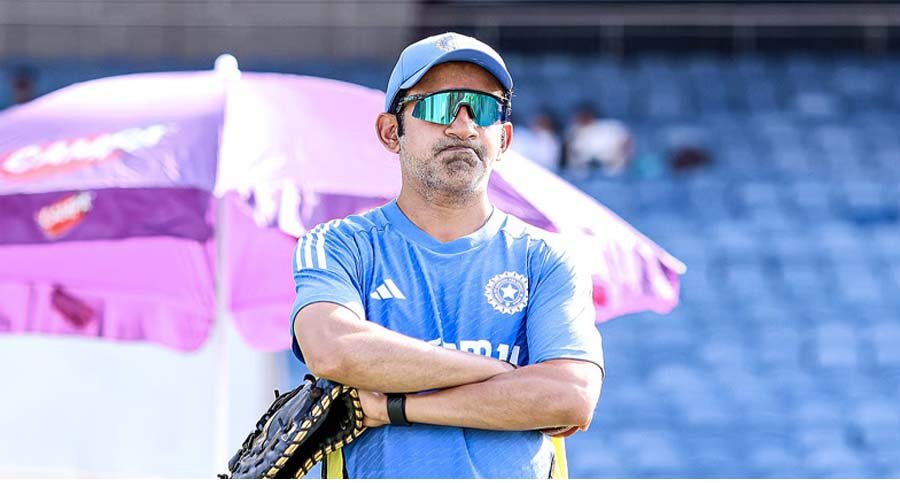

Mount Maunganui: India head coach Gautam Gambhir has expressed serious concerns over his team’s repeated batting collapses after suffering a humiliating 244-run defeat against New Zealand in the fourth ODI at Mount Maunganui on Friday.
India were bowled out for just 89 while chasing a challenging target of 334, suffering one of their heaviest defeats in recent ODI cricket. However, Gambhir insisted that his concerns extend beyond the latest result, pointing to another alarming batting collapse in the previous match.
Despite remaining 2-1 ahead in the five-match series, India had slipped to 111/7 while chasing a revised target of 135 in the rain-affected second ODI, eventually securing a narrow victory through the Duckworth-Lewis-Stern (DLS) method.
Gambhir admitted that India’s inability to handle challenging bowling conditions was becoming a significant concern, particularly with the 2027 ICC Cricket World Cup approaching.
“There’s no benefit to sweeping it under the carpet. It isn’t just this match. Even in the previous match, we were seven down for 111 or 112. Today we lost, so we are talking about it,” Gambhir said during the post-match press conference.
He acknowledged that the conditions in New Zealand offered considerable assistance to fast bowlers and stressed that Indian batters needed to improve both their mental approach and technical skills.
Gambhir also pointed out that scoring aggressively during the opening overs, as Indian batters often attempt at home, was not necessarily the right approach in overseas conditions.
“You aren’t going to score 70-80 in the first 10 overs in ODIs in these conditions. If you’re 35-40 for no loss, that is also good enough. In India, the easiest time for batting is the first 10-15 overs. Here it’s probably the hardest time,” he explained.
World Cup Conditions Add to Gambhir’s Concerns
Gambhir’s concerns have been amplified by the fact that the conditions in New Zealand could provide a useful indication of what India might encounter during the 2027 World Cup in South Africa, Zimbabwe and Namibia.
The India coach believes the upcoming tournament will present a different challenge compared to batting-friendly conditions often encountered on home soil.
He said the contest between bat and ball in New Zealand was closer to what teams could expect during the World Cup, making India’s struggles particularly worrying.
“Obviously these are conditions which are going to be closest to what we might get during the World Cup. When you play in India, there is hardly anything for the bowlers, but when you come in these conditions, there is actually a good contest between bat and ball,” Gambhir said.
He added that the biggest disappointment against New Zealand was not simply the low score but the speed at which India lost their wickets.
“For me, the bigger concern from Friday’s game is not the runs, it’s how quickly we got bundled out. I think in around 26 or 27 overs, so hopefully we can try and rectify that as soon as possible,” he added.
Matt Henry’s Six-Wicket Haul Destroys India
New Zealand fast bowler Matt Henry delivered a sensational performance on his return to the ODI side, finishing with figures of 6/27 to dismantle India’s batting lineup.
Defending 333, Henry produced a devastating opening over in which Rohit Sharma, Virat Kohli and Shreyas Iyer were dismissed without scoring, leaving India in immediate trouble.
While the wobble-seam delivery was among Henry’s effective weapons, Gambhir felt the real difficulty for Indian batters came from the lengths the New Zealand pacer consistently bowled.
According to the India coach, batters struggled to decide whether to move forward or back against deliveries landing on a difficult in-between length.
Gambhir believed India’s batters needed to show greater commitment with their footwork rather than getting stuck on the crease.
He also played down the technical discussion surrounding wobble-seam and scrambled-seam deliveries, arguing that handling movement and adapting to bowling lengths remained the responsibility of the batters.
Gambhir Defends India’s Bowling Attack
While India’s batting performance attracted most of the attention, Gambhir also discussed the bowling effort, particularly the missed opportunities that allowed New Zealand to build a commanding total.
Young New Zealand batter Will Young scored 125 after surviving two early chances off the bowling of Auqib Nabi.
Both opportunities were put down by Rohit Sharma and Ishan Kishan in successive overs, allowing Young to capitalise and steer the hosts towards a formidable total.
Gambhir felt the missed catches significantly affected India’s chances of restricting New Zealand.
He also defended the bowling approach of young pacer Gurnoor Brar, explaining that the bowler naturally relies on shorter lengths and hard-hitting deliveries.
Gambhir praised Arshdeep Singh and Auqib Nabi for their efforts, while expressing disappointment over the missed opportunities in the field.
He acknowledged that dismissing Young early could have changed the course of the innings but accepted that India had paid the price for their fielding mistakes.
Gambhir Explains Kuldeep Yadav’s Selection Over Mohammed Siraj
Gambhir also explained India’s decision to include wrist-spinner Kuldeep Yadav in the playing XI instead of another specialist fast bowler for the fourth ODI.
With Anshul Kamboj having left the ODI squad to join India’s preparations for the upcoming Test series in Wellington, India reshuffled their bowling combination.
Mohammed Siraj, who is part of the Test squad but had not featured in the ODI series, remained on the bench as India opted for Kuldeep.
Gambhir said the team management believed an additional wrist-spinner would provide a more attacking option during the middle overs, particularly on a larger ground.
“We thought that a wrist-spinner would be more useful, as simple as it can get,” Gambhir explained.
However, Kuldeep endured a difficult outing in his first match of the series, conceding 73 runs in eight overs without taking a wicket.
The spinner had not played a competitive match for more than a month before the encounter, but Gambhir dismissed suggestions that a lack of match practice had affected his performance.
He pointed out that Kuldeep had featured in India’s three-match ODI series against West Indies at home in October and said international players must remain prepared to make an impact whenever opportunities arise.
India Look to Finish Series on a Winning Note
Despite the heavy defeat, India remain 2-1 ahead in the five-match ODI series and will have an opportunity to clinch the series in the final encounter at Mount Maunganui on Sunday.
However, Gambhir will be particularly keen to see an improved batting performance, with the repeated collapses raising questions about India’s ability to adapt to challenging overseas conditions.
With the 2027 World Cup approaching, the final ODI offers India an important opportunity to address their batting concerns and regain confidence ahead of future international assignments.