
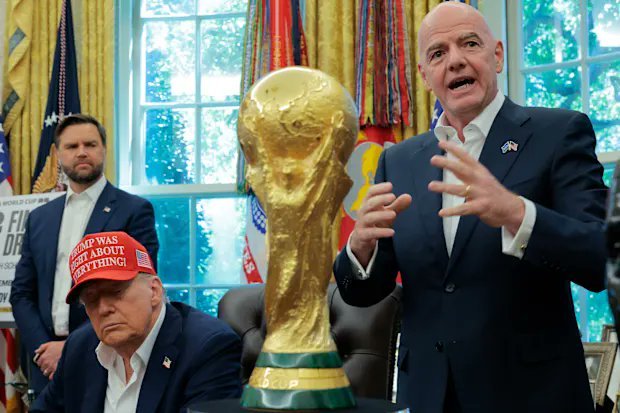

ZURICH: FIFA president Gianni Infantino is set to face mounting pressure from senior football officials at a crucial FIFA Council meeting in Zurich, as divisions over governance, financial decisions and the abandoned plan to attract private investment into the organisation threaten to deepen.
The meeting marks Infantino’s first gathering with FIFA’s top leadership since his proposed FIFA Forward Enterprise (FFE) initiative collapsed in July, exposing a significant rift between the president and influential figures across international football.
Leaders from UEFA, the Asian Football Confederation (AFC) and CONCACAF have emerged as prominent critics of Infantino’s leadership. Their representatives will join officials from Africa, South America and Oceania at the 37-member FIFA Council meeting, where the abandoned investment proposal and wider governance concerns are expected to dominate discussions.
While forcing Infantino out of office may prove difficult, his critics are reportedly seeking to restrict his authority and push for changes to FIFA’s decision-making structures.
Failed Investment Plan Triggers FIFA Fallout
The FIFA Forward Enterprise proposal became a major source of controversy after Infantino outlined plans to sell a minority stake in a FIFA commercial subsidiary to private investors.
The initiative was intended to attract substantial private capital into FIFA’s commercial operations. A company launched by Joshua Kushner, brother of Jared Kushner, the son-in-law of US President Donald Trump, was identified as the proposed lead investor.
However, the proposal was abandoned within days of its announcement in July, leaving FIFA facing questions over the initiative and its consultation with the wider football community.
The collapse of the scheme intensified existing disagreements over how FIFA should manage its financial resources and distribute development funding to its 211 member associations.
For Infantino’s opponents, the controversy has become part of a broader debate over transparency, accountability and the concentration of power within the governing body.
UEFA, AFC and CONCACAF Leaders Challenge Infantino
The dispute has brought some of international football’s most influential administrators into opposition with the FIFA president.
UEFA president Aleksander Ceferin, AFC president Salman Al Khalifa and CONCACAF president Victor Montagliani have reportedly called for a change in FIFA’s leadership following the FFE controversy.
Their positions highlight a growing divide within the organisation, although Infantino continues to retain support from several regions.
According to people familiar with the discussions, opponents of the FIFA president believe that replacing him may be difficult. Their immediate objective is therefore to strengthen oversight and limit his ability to make major decisions without sufficient consultation.
The FIFA Council meeting is expected to provide an opportunity to discuss possible changes to the organisation’s governance framework, though it remains uncertain whether the gathering will produce concrete reforms.
Infantino Mobilises Support Ahead of 2027 Election
Infantino is expected to seek another term when FIFA holds its presidential election in March 2027. The nomination deadline is November 18, placing the organisation’s leadership contest increasingly in focus.
Former Switzerland and Tottenham Hotspur defender Ramon Vega announced last week that he intended to enter the race. However, he has yet to confirm whether he has secured the backing of the five national football associations required to qualify as a candidate.
Despite the criticism, Infantino has continued to cultivate support among FIFA’s member associations.
He received a standing ovation during a meeting with African football leaders in Cape Verde last week, while South American backing is also expected to remain an important factor in his re-election campaign.
Within Asia, support for Infantino reportedly remains substantial in several countries, including among a bloc of Arab nations, despite criticism from the AFC leadership.
The competing positions underline the complexity of FIFA’s political landscape. Opposition from prominent confederation presidents does not necessarily translate into a unified campaign capable of challenging Infantino successfully at the ballot box.
Development Funding Becomes Another Flashpoint
Financial distribution is expected to be another major issue at the Zurich meeting.
UEFA and CONCACAF called last month for FIFA to release $10 million to each of its 211 member associations. Their proposal offers an alternative to the FFE initiative, under which associations could potentially receive $20 million in development funding and gain access to a further $20 million.
Council members are also expected to examine FIFA’s financial reserves and determine how much funding can be made available to national associations.
The debate raises broader questions about the balance between investing in FIFA’s commercial expansion and providing direct financial assistance to its members.
For many national associations, development funding is essential to maintaining domestic competitions, improving infrastructure and supporting grassroots football. How FIFA distributes its resources could therefore become a significant issue in the run-up to the 2027 election.
Other subjects expected to feature include disciplinary procedures, the organisation’s governance framework and the FIFA Peace Prize, which was controversially awarded to US President Donald Trump last year.
Governance Experts Demand Independent Review
The controversy has also attracted criticism from sports governance advocates, who want FIFA to use the meeting to establish a credible process for reviewing its decision-making structures.
Emanuel Medeiros, founder and global chief executive of the Sport Integrity Global Alliance, said the council needed to hold a frank discussion about the organisation’s future.
He argued that football stakeholders expected a comprehensive, transparent and genuinely independent examination of FIFA’s governance arrangements.
Miguel Maduro, a lawyer and politician who chaired FIFA’s Governance Committee in 2016 before being dismissed by Infantino, expressed considerably less optimism about the prospect of meaningful change.
Maduro suggested that FIFA could announce a working group or an independent governance review, but questioned whether either initiative would carry credibility given the organisation’s previous record.
He warned that a review without genuine independence and enforceable outcomes could amount to little more than an attempt to ease public pressure rather than address structural problems.
The contrasting assessments reflect a central challenge for FIFA: whether its leadership can establish a reform process that is trusted by critics as well as its own officials.
Will the Zurich Meeting Deliver Real Change?
The FIFA Council gathering comes at a sensitive moment for Infantino, with the failed investment plan exposing divisions among senior administrators and the next presidential election approaching.
His supporters continue to provide a substantial political base, making an immediate leadership change uncertain. At the same time, pressure for greater accountability and a more transparent approach to financial decisions is unlikely to disappear.
The key question is whether FIFA’s council members will agree on practical measures to strengthen governance or settle for limited procedural changes that leave the existing power structure largely intact.
For international football, the outcome could shape more than the future of one president. It may also influence how the sport’s governing body manages its finances, consults its members and demonstrates accountability to the associations and supporters it represents.