
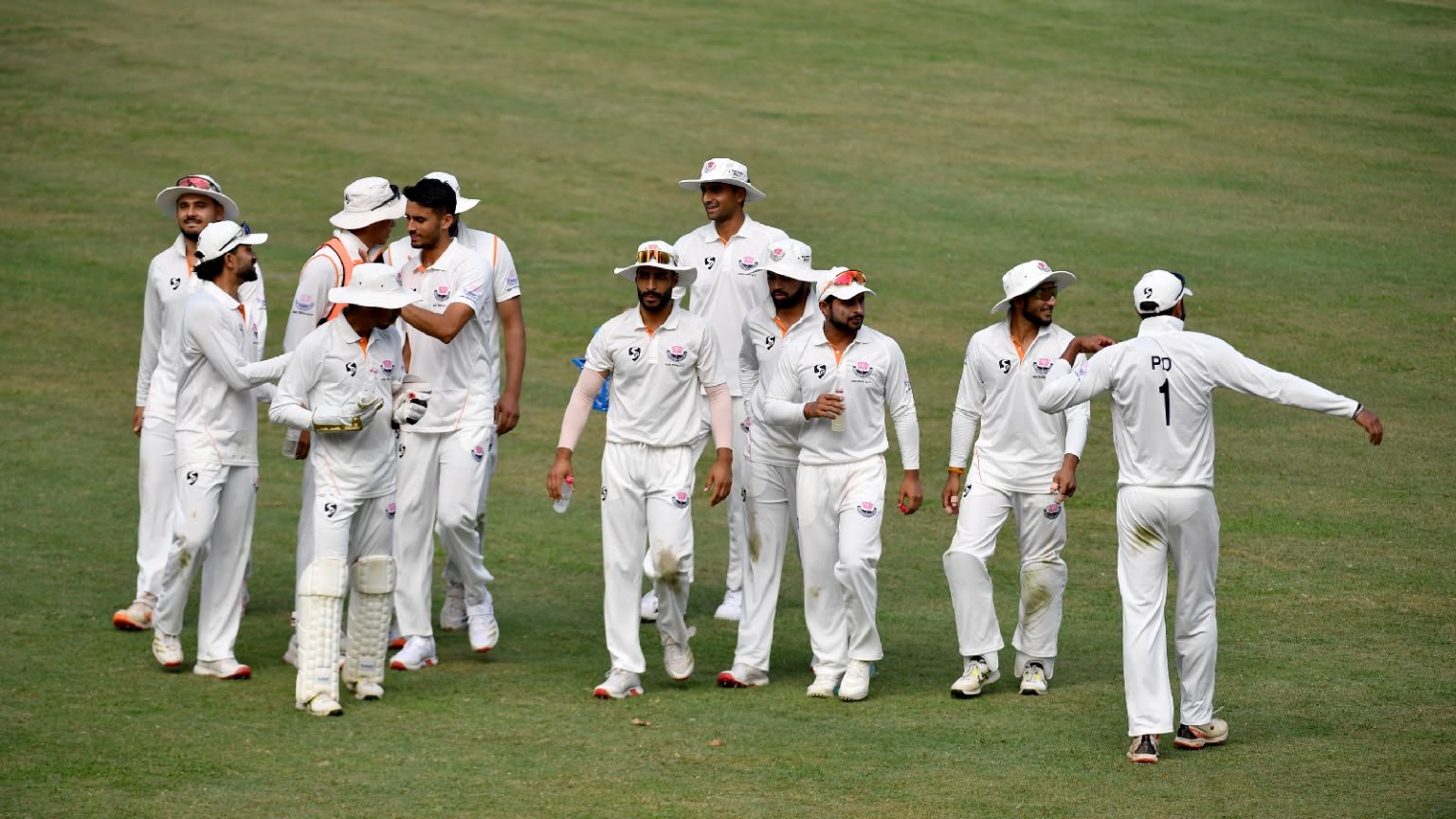

Srinagar: Defending champions Jammu and Kashmir were left counting their blessings after rain and bad light rescued them from a potential defeat against Madhya Pradesh in their Ranji Trophy Group A opener, raising fresh concerns over the team’s batting form, bowling discipline and selection decisions.
Chasing a challenging target of 326, J&K collapsed to 88 for seven before weather conditions brought an end to the contest on Wednesday. What could have been a disastrous start to their title defence instead ended in a draw, with Madhya Pradesh denied a victory they appeared well-positioned to secure.
For a team that lifted the Ranji Trophy last season, the performance offered little reassurance. More troublingly, the batting struggles were not an isolated occurrence. J&K had shown similar weaknesses in their recent Irani Cup encounter against the Rest of India, and the latest collapse suggests that the concerns surrounding their batting order remain largely unaddressed.
Batting Collapse Raises Serious Questions
J&K’s fourth-innings performance was particularly disappointing given the importance of a strong start to their title defence. The top order once again failed to withstand sustained pressure, leaving the middle and lower order with an uphill task.
Avesh Khan immediately exposed the fragility of the home side’s batting, dismissing Shubham Khajuria for a duck and Qamran Iqbal for four. Aryan Pandey then removed Shubham Pundir for four, reducing J&K to a disastrous eight for three.
The situation deteriorated further when Avesh dismissed Abdul Samad without scoring, before Pandey accounted for captain Paras Dogra, who managed only four runs. At 12 for five inside the first six overs, J&K were staring at an outright defeat.
Kanhaiya Wadhawan attempted to resist the collapse with 26 runs before retiring hurt, but Lone Nasir’s dismissal for 13 left the hosts struggling at 51 for six.
Auqib Nabi remained unbeaten on 30 when play was abandoned, but his resistance could not disguise the scale of the batting failure.
Avesh finished with three wickets for 30 runs, while Pandey claimed three for 31. Their incisive spells exposed a J&K batting unit that appeared short of answers against disciplined pace bowling.
Top Order Continues to Underperform
The repeated failure of J&K’s top order is becoming an increasingly difficult issue to overlook.
Shubham Khajuria and Shubham Pundir were among the early casualties against Madhya Pradesh, contributing little in a chase that demanded composure, application and responsibility. Their dismissals added to the growing concerns over the consistency of J&K’s batting lineup.
Questions are now likely to be asked about the continued selection of both batters despite their recurring failures. How much longer can the team afford to persist with an underperforming top order without demanding greater consistency or considering alternatives?
Selection continuity can be valuable in red-ball cricket, particularly when players are given time to develop confidence and establish themselves. However, continuity must also be supported by performance, or at least clear signs of improvement.
For a defending champion, the issue is not simply about individual scores. It is about whether the team is selecting its most effective combination and responding to weaknesses that opponents are increasingly able to exploit.
J&K’s management will need to assess whether the existing batting order has the technical resilience and temperament required to compete consistently at the highest level of domestic cricket.
Irani Cup Struggles Still Haunt J&K
The defeat they narrowly avoided against Madhya Pradesh also brings back memories of J&K’s recent Irani Cup outing against the Rest of India.
That contest had already raised concerns about the champions’ ability to match a strong opposition, particularly when their batters came under sustained pressure. The latest Ranji Trophy performance has done little to suggest that the lessons from that encounter have translated into meaningful improvement.
Instead, the familiar pattern has resurfaced: early wickets, mounting pressure on the middle order and an innings in which the team struggles to build a substantial response.
A single poor innings should not define a side, but repeated collapses across important fixtures demand closer scrutiny. J&K cannot rely indefinitely on individual contributions or favourable circumstances to escape difficult situations.
The question confronting the defending champions is straightforward: what has changed since the Irani Cup?
If the same weaknesses continue to appear, the team management must identify whether the problem lies in preparation, technique, temperament, selection or a combination of these factors.
Bowling Effort Also Falls Short of Expectations
While the batting collapse dominated the final day, J&K’s bowling performance over the preceding innings also deserves scrutiny.
Madhya Pradesh resumed their second innings at 151 for five and eventually declared at 249 for six, setting J&K a target of 326. Captain Shubham Sharma anchored the innings with an unbeaten 106 off 200 deliveries, striking seven fours and three sixes.
Atharva Mahajan contributed 39 off 94 balls, while Saransh Jain accelerated the scoring with an unbeaten 35 off just 33 deliveries.
Sharma and Mahajan added 75 runs, helping Madhya Pradesh consolidate their position before Jain provided a late scoring boost.
Auqib Nabi was J&K’s most successful bowler, claiming three wickets for 53 runs, while Sunil Kumar took two wickets. However, the overall effort failed to prevent Madhya Pradesh from building a commanding lead.
In conditions that appeared conducive to bowling, J&K needed greater discipline, sharper execution and a more consistent ability to exploit opportunities. Instead, Madhya Pradesh’s batters were allowed to build partnerships and extend their advantage.
The conditions alone cannot determine how a team should perform, but when assistance is available to the bowlers, failing to apply sustained pressure can prove costly. J&K’s inability to restrict Madhya Pradesh earlier left their own batters facing an imposing fourth-innings target.
The bowling effort was not without individual positives, particularly Nabi’s contribution, but the team will need a more coordinated performance if it hopes to defend its title successfully.
A Draw That Offers Little Comfort
Rain and bad light ultimately denied Madhya Pradesh the opportunity to complete what looked like a convincing victory. For J&K, the draw provides a point but little reason for satisfaction.
The defending champions were outplayed during the decisive phase of the contest and were fortunate that the weather intervened before the result could be settled on the field.
Other Group A results saw Vidarbha defeat Puducherry by 160 runs in Nagpur, while Baroda beat Goa by an innings and 135 runs in Panaji.
J&K’s immediate challenge is to turn the reprieve into a wake-up call. Their championship credentials will be tested not by their reputation as defending champions, but by how quickly they address the shortcomings exposed in their opening fixture.
The batting order needs greater reliability, the bowling unit must make better use of favourable conditions, and the selectors must be prepared to evaluate performances objectively.
A title-winning season can provide confidence, but it cannot guarantee future success. If the problems exposed in the Irani Cup continue into the Ranji Trophy, J&K risk allowing familiar weaknesses to undermine their title defence.
The weather may have saved them from defeat against Madhya Pradesh. It cannot be expected to rescue them every time.