
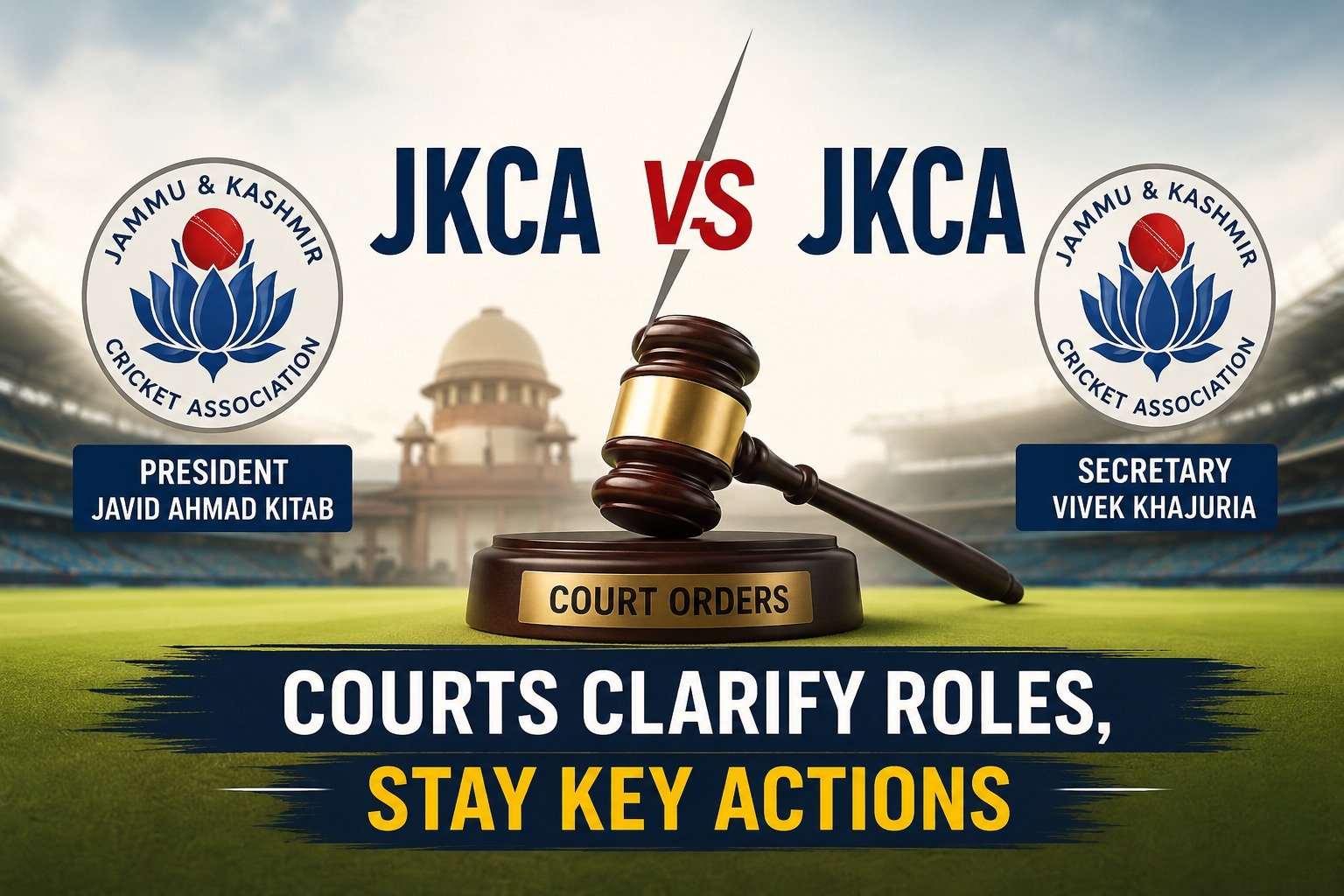

Srinagar/Jammu, June 7: Two separate court orders delivered on June 6 have dealt significant blows to actions taken without the concurrence of newly elected Jammu & Kashmir Cricket Association (JKCA) President Javid Ahmad Kitab, while also clarifying the limits of authority exercised by various office-bearers under the JKCA Constitution.
In the first case, the Court of the Additional District Judge, Srinagar, partly upheld Kitab’s challenge against notices issued by JKCA Secretary Vivek Khajuria for Apex Council meetings. In the second case, the 1st Additional District Judge, Jammu, dismissed an appeal challenging an earlier stay order on a Special General Meeting (SGM) called by President Kitab, thereby allowing the interim stay to continue.
Srinagar Court: Secretary Cannot Convene Meetings Without President’s Concurrence
The Srinagar court was hearing a petition filed by JKCA President Javid Ahmad Kitab challenging communications issued by Secretary Vivek Khajuria, including notices convening Apex Council meetings on May 26 and June 1.
Kitab argued that the Secretary had acted unilaterally, without obtaining the mandatory concurrence of the President as required under Rule 15(c)(iv) of the JKCA Constitution. He also challenged the induction of ICA nominees Vikrant Taggar and Ankita Jalla into the Apex Council.
After examining the JKCA Constitution, the court held that while the Secretary possesses wide administrative powers, meetings of the Apex Council, General Body and other governing bodies must be convened only with the concurrence of the President.
The court observed that:
The Secretary’s role is primarily administrative and facilitative.
Concurrence of the President is a mandatory pre-condition for convening Apex Council meetings.
Even where three councillors requisition a meeting, the Secretary must still obtain the President’s concurrence.
The notices issued for meetings on May 26 and June 1 did not reflect such concurrence and therefore appeared prima facie contrary to the JKCA Constitution.
The court further remarked that no office-bearer could be permitted to act unilaterally or assume powers not vested in him under the Constitution and noted that the Secretary’s actions appeared designed to dilute the authority vested in the elected President.
However, the court rejected Kitab’s challenge to the inclusion of ICA nominees Vikrant Taggar and Ankita Jalla in the Apex Council. It held that their nomination flowed from a communication issued by the Indian Cricketers’ Association (ICA) and that the Secretary merely notified those nominations. Consequently, the court found no illegality in the resolutions concerning their induction.
While disposing of the petition, the court stayed the operation of the impugned communications relating to the convening of Apex Council meetings and directed that all future meetings of JKCA be conducted strictly in accordance with the Constitution.
Jammu Court Dismisses Appeal Against Stay on President’s SGM Notice
In a parallel development, the 1st Additional District Judge, Jammu, dismissed an appeal challenging an interim order passed on June 2 by the Sub Judge/Special Mobile Magistrate, Jammu.
The trial court had stayed the operation of communications issued by President Javid Ahmad Kitab on May 26 and May 29 relating to a proposed Special General Meeting (SGM) scheduled for June 6.
The appellant argued that the President had authority to convene the meeting and that the trial court had erred in granting an ex-parte injunction.
However, the appellate court held that substantial constitutional questions existed regarding whether the President could independently issue the SGM notice and whether the procedure prescribed under the JKCA Constitution had been followed.
The court observed that:
Rule 15(c)(iv) vests the function of convening meetings in the Secretary, albeit with the concurrence of the President.
Rule 17 contemplates that Special General Meetings are ordinarily convened by the Secretary on the President’s direction.
The President issued a direction on May 26 and thereafter personally issued an SGM notice on May 29, raising questions about whether the conditions prescribed under Rule 17(e) had been satisfied.
These issues require detailed adjudication after pleadings and cannot be conclusively decided at the interim stage.
The appellate court also rejected arguments relating to suppression of facts, authority of the Secretary to institute the suit, and the existence of parallel proceedings in Srinagar, holding that all such issues would be examined by the trial court during final adjudication.
Finding no perversity or illegality in the June 2 order, the court dismissed the appeal and affirmed the stay on the proposed SGM.
Key Points To Note :
The two June 6 orders leave JKCA in a unique situation:
The Srinagar court has held that Apex Council meetings cannot be convened by the Secretary without the President’s concurrence.
The Jammu court has simultaneously upheld the stay on the President’s proposed Special General Meeting pending detailed examination of whether it was convened in accordance with constitutional procedure.
The induction of ICA nominees Vikrant Taggar and Ankita Jalla into the Apex Council has, for now, survived judicial scrutiny.
Both courts emphasized strict adherence to the JKCA Constitution and indicated that final determination of the wider governance dispute will take place during the trial proceedings.
The ongoing litigation underscores the deepening power struggle within the newly elected JKCA administration, with both the President and other office-bearers seeking judicial interpretation of their respective constitutional powers.